Laser Welding Machine Guide and How to Choose Suppliers in UAE
Laser Welding Machine Guide and How to Choose Suppliers in UAE
What is a laser welding machine and how does it work?
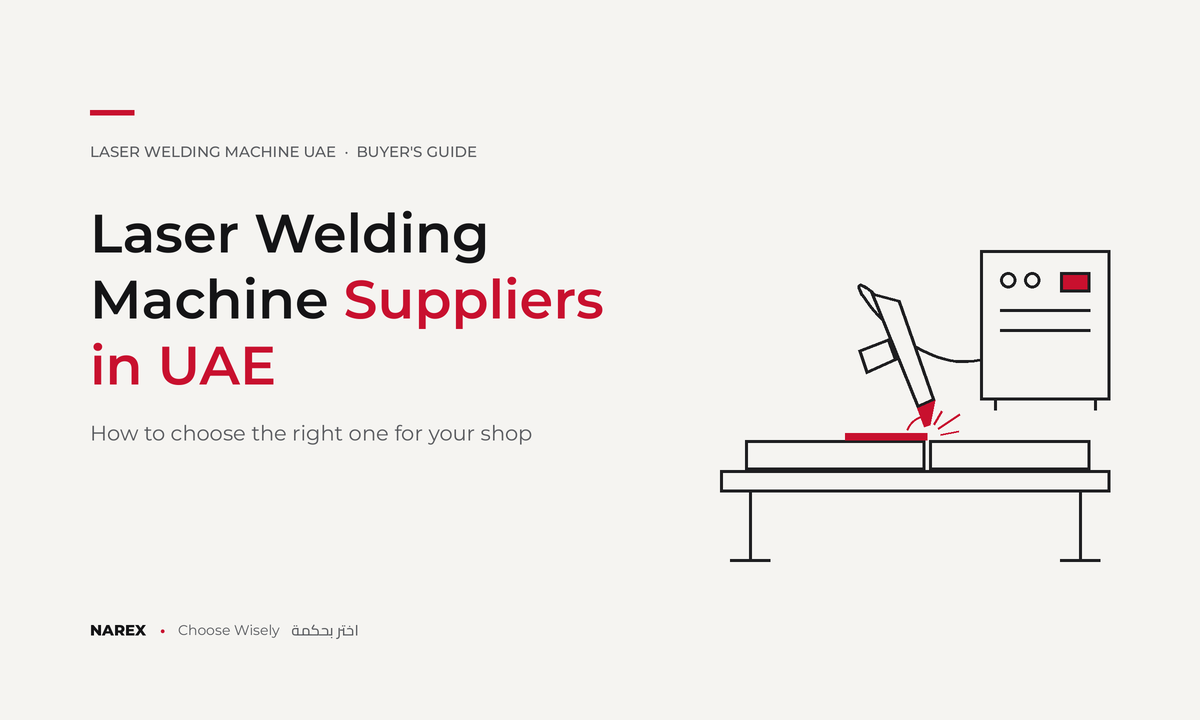
A laser welding machine melts the edges of two metal parts with a concentrated beam of light, and the molten metal fuses as it cools. Because the heat is focused on a small spot, the surrounding metal stays cooler than with arc welding.
Most machines sold in the UAE today are fiber laser welding machines. Four parts do the work:
- Fiber laser source. Generates the beam and sends it through a flexible fibre cable to the welding head. Its rated power (in watts) sets how thick a material you can weld.
- Wobble head. Moves the beam in a small, fast pattern (circle, line or figure-eight). This widens the weld seam slightly, so small gaps between parts are easier to bridge.
- Wire feeder. Pushes filler wire into the joint when you need extra metal, for example on fillet welds or wider gaps. Many thin-sheet butt joints are welded without wire.
- Shielding gas. Argon or nitrogen flows over the weld to stop oxidation. This keeps stainless steel bright and reduces porosity.
A chiller (water cooling unit) keeps the laser source and head at a stable temperature. In UAE summer workshops, cooling capacity matters more than most buyers expect.
Shop-floor tip: Clean the joint before welding. Oil, mill scale and protective film on stainless sheet cause porosity faster than any machine setting.
Types of laser welding machines
There are three main types. The right one depends on your part volume, part size and how varied your jobs are.
Handheld laser welding machine
The operator holds a welding gun connected to the laser source by a fibre cable, much like a TIG torch. It suits job shops, kitchen equipment makers and furniture fabricators who weld many different parts in small batches.
The learning curve is short for most operators, and the machine moves easily around the workshop on its trolley.
Automatic or robotic laser welding machine
The welding head is mounted on a CNC table, a gantry or a robot arm. It repeats the same seam on every part with consistent quality.
This type suits factories with high volumes of identical parts, such as enclosures or appliance panels. It needs fixtures, programming and a higher investment.
3-in-1 laser welding, cleaning and cutting machine
A 3-in-1 laser welding cleaning cutting machine uses one laser source with interchangeable nozzles or heads. You can weld, clean rust or oxide before and after welding, and make light cuts on thin sheet.
It suits small and mid-size workshops that want one machine for several tasks. Cutting on these machines is for trimming and light work, not a replacement for a fiber laser cutting machine.
Shop-floor tip: If more than one operator will use the machine, choose a model with saved parameter programs. It keeps weld quality consistent between shifts.
Laser welding vs TIG vs MIG
Laser welding is usually faster than TIG on thin sheet and leaves less heat distortion, but it needs tighter joint fit-up. MIG remains practical for thick structural steel. The table compares them in general terms; actual results depend on material, thickness and joint design.
| Factor | Laser welding | TIG welding | MIG welding |
|---|---|---|---|
| Speed on thin sheet | Fast | Slow | Medium |
| Heat distortion | Low, narrow heat zone | Medium to high | Medium to high |
| Weld finish | Clean, narrow seam; little grinding | Neat, but often needs polishing on stainless | Spatter; usually needs grinding |
| Operator skill | Short learning curve for basic seams | High skill and experience needed | Moderate skill |
| Consumables | Shielding gas, protective lenses, nozzles, optional wire | Tungsten electrodes, filler rod, argon | Wire, gas, contact tips |
| Running cost | Electricity and gas; lower labour time per part | Higher labour time per part | Lower equipment cost; more post-weld finishing |
| Joint fit-up | Tight gaps needed | Tolerates wider gaps | Tolerates wider gaps |
| Upfront machine cost | Higher | Lower |
Applications in the UAE and GCC
Laser welding works well where parts are thin to medium gauge and the weld is visible. These are the jobs we see most often in workshops across Sharjah, Dubai, Abu Dhabi and the wider GCC:
- Commercial kitchen equipment. Stainless sinks, worktops, hoods and tables, where clean seams reduce polishing time and are easier to keep hygienic.
- Stainless steel furniture. Frames, railings and decorative pieces for hotels, malls and villas, where a neat seam matters.
- Signage. Stainless and aluminium channel letters and sign boxes, which distort easily under TIG heat.
- Doors and windows. Steel and aluminium frames, security doors and gates.
- HVAC ducting. Galvanized and stainless duct joints and flanges, with fume extraction in place.
- Electrical enclosures and cabinets. Panel corners and seams for switchgear and control boxes, where flat panels and consistent welds save rework.
If your work is mostly heavy structural steel above medium thickness, a laser may not replace your MIG line. Ask for a test on your own parts before deciding.
Benefits and limitations
Laser welding saves time on thin, visible work, but it is not the right tool for every job. Here is a balanced view.
Benefits
- Faster welding on thin sheet, so more parts per shift.
- Low heat distortion, which means flatter panels and less straightening.
- Clean, narrow seams that need little or no grinding.
- Shorter training time for new operators on basic seams.
- Fewer consumables than arc welding, with no tungsten to regrind.
- 3-in-1 flexibility, where one machine also cleans and makes light cuts.
Limitations
- Joint fit-up must be good. Laser beams are narrow. Large or uneven gaps lead to weak or incomplete welds. Wobble heads and filler wire help, but they don’t fix poor cutting or bending.
- Reflective metals need care. Aluminium, copper and brass reflect laser energy. They need more power, clean surfaces and correct settings.
- Laser safety is serious. The beam can damage eyes and skin, including from reflections. You need laser-rated eyewear for the correct wavelength, a controlled welding area and trained staff.
- Fume extraction is still needed, especially on galvanized and coated metals.
- Upfront cost is higher than a TIG or MIG set, so the return depends on your weld volume.
Shop-floor tip: Never let visitors watch a demo without laser safety glasses. Sunglasses and standard welding helmets are not rated for fiber laser wavelengths.
Laser welding machine price in the UAE: what affects it
Laser welding machine prices in the UAE vary widely, so two quotes that look similar can cover very different machines. Compare these factors line by line:
- Wattage. Higher power costs more. Buy for your usual thickness, with some headroom.
- Laser source brand. The source is the most expensive part. Ask which brand it is and where service comes from.
- Cooling system. A chiller sized for UAE ambient temperatures protects the source in summer. Undersized cooling causes alarms and downtime.
- Wire feeder. Single or double wire feeders add cost but widen the jobs you can take on.
- Functions. A 3-in-1 machine with cleaning and cutting heads costs more than a welding-only unit.
- Warranty. Check what is covered (source, head, chiller) and for how long.
- Installation and training. Confirm whether on-site setup and operator training are included in the price.
- Spare parts kit. Protective lenses and nozzles wear out. A starter kit avoids early stoppages.
We don’t publish fixed prices because the right configuration depends on your material and volume. [Request a quote on WhatsApp](https://wa.me/[WhatsApp number]) with your material, thickness and typical part, and our team will recommend a configuration.
How to choose laser welding machine suppliers in the UAE
The supplier matters as much as the machine. A good machine with slow support can stand idle for weeks. Use these eight criteria to compare laser welding machine suppliers in the UAE.
1. Local stock
Ask if the machine is in a UAE warehouse or still to be shipped. Local stock means you can inspect it and start production sooner.
2. In-house engineers
Check whether the supplier has its own service engineers or relies on a third party. Ask how many engineers they have and where they are based.
3. Spare parts availability
Protective lenses, nozzles, copper tips and fibre connectors wear out. Ask which parts are held in stock locally and how fast they can be delivered.
4. Laser source brand
The laser source decides long-term reliability. Ask for the brand and model, and how source repairs are handled under warranty.
5. Live demo on your material
A video is not a test. Ask to weld your own parts, in your thickness and joint type, at the supplier’s showroom.
6. Installation and training
Confirm who installs the machine, and how many days of operator training are included. Training should cover parameters, safety and basic maintenance.
7. After-sales response time
Ask for a clear response time for breakdowns, and whether support is available by phone, WhatsApp and on site. Get it in writing.
8. Warranty terms
Read what the warranty covers: laser source, welding head, chiller and electronics. Check who pays for parts, labour and engineer visits during the warranty period.
Shop-floor tip: Before you buy, call the supplier’s service number on a Friday afternoon. How quickly they answer tells you a lot.
Local supplier vs online or overseas import
An imported machine can look cheaper on paper, but the total cost of ownership often tells a different story.
| Factor | Local UAE supplier | Online or overseas import |
|---|---|---|
| Purchase price | Includes local stock, service and support costs | Often lower list price; add shipping, customs and clearance |
| Lead time | Days, if in local stock | Weeks, plus clearance time |
| Technical support | Local engineers, same time zone, on-site visits | Remote support by video or email; time-zone delays |
| Warranty claims | Handled locally; parts swapped in UAE | Parts may need to be shipped abroad and back |
| Training | On-site operator training after installation | Manuals and videos; often no hands-on training |
| Total cost of ownership | Higher upfront, lower downtime risk | Lower upfront, higher risk of long downtime |
Laser welding machines at Narex IND
Narex IND stocks the BOCO WELD range of 4-in-1 laser welding and cutting machines at our showroom in Sharjah Industrial Area 2. Here is what buying a laser welding machine in Sharjah from us includes:
- Live demos at the Sharjah showroom. Bring your own parts and see them welded before you decide. The showroom is a short drive from Dubai and the Northern Emirates.
- Installation. Our engineers install and commission the machine at your workshop.
- Operator training. One day of operator training after installation, covering settings, safety and routine care.
- 24-hour support. Our team of 35+ engineers responds around the clock.
- Experience. We have supplied industrial machinery since 1994 and installed more than 10,000 machines across the UAE, GCC and Africa.
- Warranty. [Warranty terms: confirm coverage and duration before publishing.]
We also supply fiber laser cutting, plasma cutting and CNC press brakes, so one partner can support your cutting, bending and welding.
Frequently asked questions
Who supplies laser welding machines in Sharjah?
Narex IND supplies BOCO WELD laser welding machines from its showroom in Sharjah Industrial Area 2. Machines are available for live demos, with installation, operator training and 24-hour support.
Is laser welding stronger than TIG?
With correct fit-up and settings, a laser weld can be as strong as a TIG weld on thin to medium sheet. Strength depends on joint design, penetration and material, so test your own parts before deciding.
What wattage do I need for 3mm stainless steel?
It depends on the machine, the joint type and the speed you need. [Insert recommended wattage for 3mm stainless from BOCO WELD spec sheet.] We recommend a test weld on your material to confirm.
Do I need gas for laser welding?
Yes, in most cases. Argon or nitrogen shielding gas protects the weld from oxidation, keeps stainless bright and reduces porosity.
Can I see a laser welding demo before buying in the UAE?
Yes. Narex IND offers live demos at the Sharjah showroom. Bring your own parts so you can judge the weld on your actual work.
How much does a laser welding machine cost in the UAE?
The price depends on wattage, laser source, cooling, wire feeder, functions and warranty. Share your material and thickness on WhatsApp to get a quote for the right configuration.
Can a handheld laser welding machine weld aluminium?
Yes, with enough power, clean surfaces and the right settings. Aluminium reflects more laser energy than steel, so it usually needs higher wattage for the same thickness.
How long does it take to learn laser welding?
Operators with basic welding experience can usually produce simple seams after hands-on training. Narex IND includes one day of operator training after installation; skill on complex joints builds with practice.