1kW or 12kW? The Fiber Laser Power Your UAE Workshop Needs
1kW or 12kW? The Fiber Laser Power Your UAE Workshop Needs
It’s the question that decides your whole investment — and the one most UAE workshops get wrong: how much fiber laser power do you actually need? Buy too little and you can’t take the jobs that pay. Buy too much and you’ve sunk capital into wattage that sits idle, burning electricity every shift. This guide matches laser power to real workloads for Sharjah, Dubai and Abu Dhabi fabricators — from 1kW to 12kW — so you buy the machine your work needs, not the one a salesperson wants to sell.
The one rule that prevents an expensive mistake
Higher wattage does two things: it raises the maximum thickness you can cut, and it increases cutting speed. It does not improve how a thin part comes out — a 1kW and a 12kW machine cut a 2mm bracket to an identical finished quality. So the decision isn’t “more power is better.” It’s “which power carries the work I actually do, day in and day out.”
The costly error is buying for the rare exception. A successful test cut through one thick plate proves the beam can penetrate that material once — it does not prove the machine can process a full queue quickly, hold edge quality and hit your delivery dates. Buy for your volume-weighted core workload; if a heavier job appears a few times a year, outsourcing it is often cheaper than the annual cost of owning extra capacity you rarely touch.
Fiber laser power by thickness — the numbers that matter
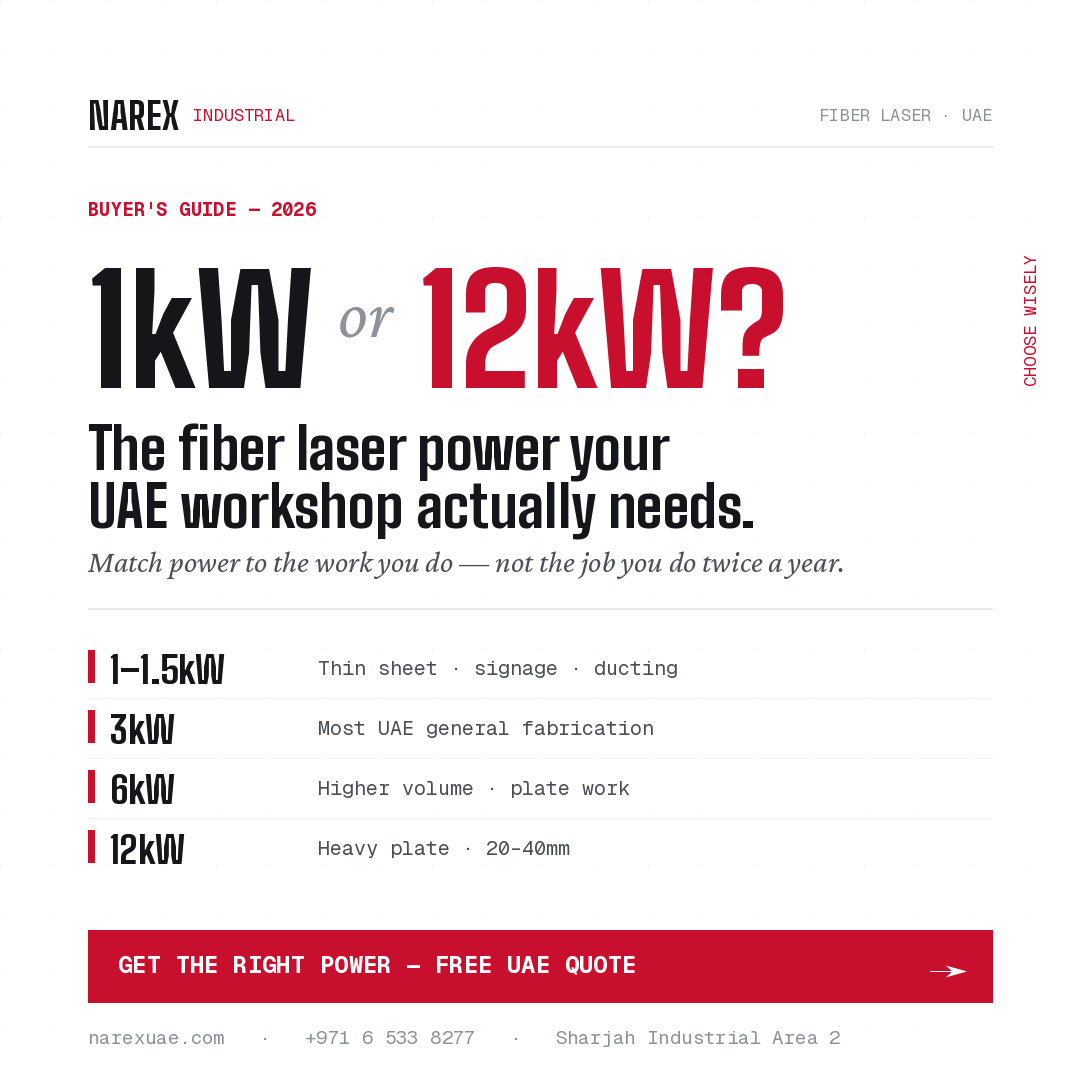
This matrix maps power to cutting capability across the metals UAE shops handle most. Figures are maximum clean-cut capability; realistic production thickness (cut repeatedly at speed and quality) is usually one step lower, and depends on assist gas, nozzle and material grade.
| Power | Carbon steel | Stainless steel | Aluminium | Cutting speed (thin sheet) |
|---|---|---|---|---|
| 1–1.5kW | up to ~10–12mm | up to ~5mm | up to ~4mm | Moderate |
| 3kW | up to ~16–20mm | up to ~8–10mm | up to ~8mm | Fast |
| 6kW | up to ~22–25mm | up to ~12mm | up to ~12mm | Very fast |
| 12kW | up to ~40mm | up to ~30mm | up to ~20mm | Extreme (thin-sheet throughput) |
Two patterns worth noting for a UAE buyer. First, aluminium, brass and copper are reflective and cut at a lower maximum thickness than carbon steel at the same power — if these are core materials, size up. Second, above 6kW the biggest gain is often speed on thin sheet, not just thickness: a 12kW machine can cut 1mm stainless several times faster than a 3kW machine, which only pays off if you run high-volume thin-sheet production.
Which power for which workshop?
Power isn’t the only cost — check these before you decide
Wattage sets the sticker price, but running cost scales with it too. A higher-power source draws more electricity and, on stainless work, burns more high-pressure nitrogen — the largest hidden operating cost in the UAE. Across the industry, the purchase price is only about 35–45% of the five-year cost of ownership. So an over-powered machine costs you twice: once at purchase, and again on every shift it runs harder than the job needs. For how those costs break down by configuration, this independent cutting-parameter reference is a useful cross-check alongside a local quote.
When you compare quotes, compare like for like: the same automation, cutting head, software, gas system and service scope — so you’re measuring the value of the wattage, not a bundle of extras. A local supplier who quotes the full picture, installs, trains your operators and stocks spares in-country is what turns the right power tier into a running production asset. That’s the model Narex has run from Sharjah Industrial Area 2 since 1994 — 10,000+ machines installed and 35+ engineers across the UAE and GCC. See the range on the CNC fiber laser cutting machines , or explore the wider machinery lineup on the Narex home page.
Frequently asked questions
How much fiber laser power do I need?
Match power to your volume-weighted core workload — the thickness and material you cut most often — not the rare heavy job. Most UAE general-fabrication shops are well served by 3kW; thin-sheet shops by 1–1.5kW; higher-volume or plate shops by 6kW; heavy plate by 12kW.
Is a 1kW fiber laser enough for a small workshop?
Yes, if your work is mostly thin sheet up to ~5–6mm — sign-making, ducting, light enclosures. It’s the most economical entry point. Outsource the occasional heavy job rather than buying more power than your core workload needs.
What is the difference between 3kW and 6kW fiber laser?
A 3kW machine covers most general fabrication up to ~16–20mm carbon steel at a lower cost. A 6kW machine cuts thicker (up to ~22–25mm), pierces and cuts faster, and suits higher volumes and multi-shift operation — the better return when plate work is regular.
Does more laser power mean a more accurate cut?
No. Higher power increases maximum thickness and cutting speed, not accuracy. A 1kW and a 12kW machine cut a thin part to the same finished quality — so don’t buy power to improve tolerances you already meet.
Do reflective metals like aluminium need more power?
Yes. Aluminium, brass and copper are reflective and cut at a lower maximum thickness than carbon steel at the same wattage. If these are core materials, size the power up accordingly.
Should I buy extra power to future-proof?
Buy for today’s core workload plus modest headroom — typically one tier up at most. Over-buying wastes capital and raises running costs. Where growth is likely, confirm a field-upgrade path (e.g. 6kW to 12kW) instead of paying for idle capacity now.
Choose Wisely — the right power, backed by local service
Established 1994 · 10,000+ machines installed · 35+ engineers across the UAE & GCC. Talk to an engineer who’ll match the machine to your work, not upsell wattage you won’t use.