Roll Forming Machine: Types, Uses & Buying Guide
Roll Forming Machine: Types, Uses & Buying Guide
What is a roll forming machine?
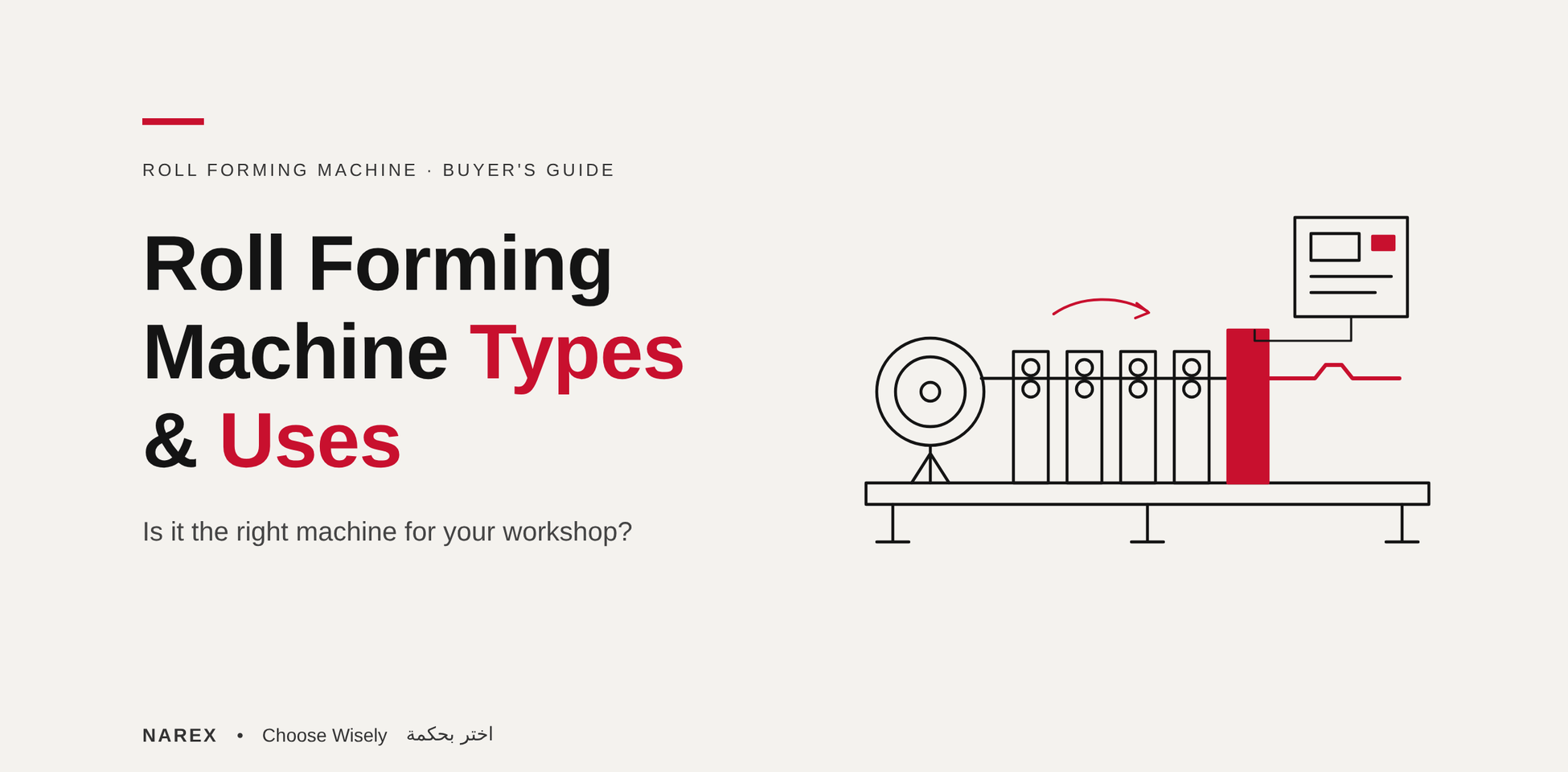
A roll forming machine is a production line that bends a continuous steel strip into a fixed cross-section at room temperature. The strip passes through pairs of shaped rollers called forming stations. Each station adds a small bend until the final profile forms. The profile is then cut to the programmed length.
This process is called cold roll forming, because the metal is not heated. Shaping happens in gradual steps, so coated steels such as galvanised steel (GI) and pre-painted steel (PPGI) keep their coating. Every metre leaving the line has the same cross-section.
How does a roll forming machine work?
- Decoiling: a decoiler (a mandrel that holds the steel coil) unwinds the strip.
- Feeding and punching: guides centre the strip; on punching lines, a servo feeder (a motor-driven feed with position control) indexes it into hydraulic punches.
- Forming: the strip passes through the forming stations, bending a little at each one.
- Cutting: a hydraulic post-cut (a shear with a profile-shaped blade) cuts each piece to length.
- Run-out and stacking: finished pieces move onto a table or automatic stacker.
A PLC (programmable logic controller) runs the sequence. Operators enter lengths, quantities and hole positions on the HMI (human-machine interface), a touchscreen panel.
What is a roll forming machine used for?
A roll forming machine makes long, uniform metal profiles in volume. Typical products include roof and wall sheets, purlins, strut channel, cable tray parts, shelf beams, rolling shutter slats and ceiling channels. These profiles go into buildings, plants, warehouses, MEP installations and storage systems. Each machine is tooled for one profile family.
Here is how the main workshop sectors use roll formed profiles:
| Sector | Typical roll formed products | Matching Narex machine category |
| Metal fabrication & steel structures | Purlins, roof and wall sheet, corrugated sheet | C & Z purlin, roof sheet, corrugated sheet |
| Oil & gas support and MEP contractors | Strut (slotted) channel, cable support members | Slotted channel forming |
| Warehousing, storage and workshop fit-out | Pallet racking beams, shelving | Shelf beam |
| Automotive service centres and garages | Rolling shutter doors, building cladding | Door shutter system, roof sheet |
| Interior and general engineering contractors | Ceiling and partition channels, insulated panels | False ceiling & partition, sandwich panel press |
An automotive repair shop rarely needs a roll former for its own repair work. The fit is stronger when a business supplies building, MEP or storage products to others.
In our work with GCC fabricators, the strongest cases share one trait. The workshop is already buying the same profile every month in large quantities.
Is a roll forming machine worth it for your workshop?
A roll forming machine is worth it when you produce the same profile regularly, in long lengths, at steady volume. It is usually not worth it for one-off shapes, frequent design changes or very low monthly volume. In those cases, a press brake or buying from a stockist costs less overall.
Ask four questions before you request a quote:
- Volume: do you use or sell the same profile every week?
- Length: do you need lengths longer than your press brake bed?
- Control: do supply delays or stockist prices hold back your projects?
- Market: can you sell surplus output to contractors or other fabricators?
If you answer “yes” to at least two, a roll former deserves a serious look. If not, start with a press brake and revisit roll forming as volume grows.
Roll forming machine vs press brake
| Factor | Roll forming machine | Press brake |
| Production style | Continuous, one profile family | Piece by piece, many shapes |
| Part length | Any programmed length | Limited by bed length |
| Labour per metre | Low once running | Higher; bend by bend |
| Changeover | Slower; rollers or stations adjusted | Faster; dies changed |
| Thickness | Thin to medium gauge | Thin sheet to thick plate |
| Suited to | High-volume repeat profiles | Job shops and varied orders |
Verdict: choose a roll former for repeat volume and long lengths. Choose a press brake for variety and thicker plate. Many established workshops run both.
Which roll forming machine specifications matter most?
The specifications that matter most are coil material and thickness range, number of forming stations, roller and shaft quality, cutting system, punching options and control system. These decide which profiles you can make, how long the tooling lasts and how much labour the line needs. Line speed matters less than most buyers expect.
| Specification | What it means | What to ask the supplier |
| Coil material | GI (often to ASTM A653), PPGI or Galvalume (aluminium-zinc coated steel) | Which materials and yield strengths is the tooling rated for? |
| Thickness range (mm) | Thinnest to thickest strip the rollers can form | What is the maximum at my coil’s yield strength? |
| Forming stations | Number of roller pairs; more stations give gentler bends | Why this number of stations for my profile? |
| Roller material | Steel grade, hardening and chrome plating | What hardness and plating thickness |
| Shaft diameter (mm) | Thicker shafts resist bending under load | What size, and is it solid steel? |
| Cutting system | Hydraulic post-cut, pre-cut or flying cut | How clean are the cut ends on my profile? |
| Punching | Inline hydraulic punches for holes and slots | Are hole positions programmable from the HMI? |
| Line speed (m/min) | Forming speed, excluding cutting stops | What is the real output per hour at my piece length? |
| Controls | PLC + HMI for lengths, batches and holes | Which PLC brand, and are spares stocked locally? |
| Power (kW) | Main drive plus hydraulic pump | What is the total load at 380V/50Hz three-phase? |
In our installations across the GCC, roller quality and shaft size tend to decide long-term output. Headline line speed rarely does.
What affects roll forming machine price?
Roll forming machine price depends mainly on profile complexity, thickness range, automation and tooling quality. A simple single-profile line costs far less than a multi-profile line with punching, servo feeding and auto-stacking. Installation, training, spare parts and shipping also belong in the comparison. An exact quote starts from your profile drawing.
The main cost drivers are:
- Profile complexity: more bends need more stations and more roller steel.
- Thickness and strength: heavier gauges need larger shafts, stronger frames and more power.
- Automation: hydraulic decoilers, servo feeders, flying cut and stackers each add cost.
- Punching and notching: extra dies and control logic.
- Multi-profile design: double-layer, quick-change or automatic size change.
- Landed cost: shipping, customs, installation, operator training and a spare parts kit.
A low invoice price can hide a high running cost. Missing spares and slow support turn into lost production days.
How do you choose the right roll forming machine? 8-step checklist
Start with the profile drawing and the volume you need, then match the machine to both. Check material, thickness, cutting, punching and controls. Confirm your site can take the machine. Finally, compare after-sales support, because a stopped line costs more than any price difference.
- ☐ Profile drawing: share full dimensions and tolerances.
- ☐ Material: confirm GI, PPGI or Galvalume, yield strength and coating.
- ☐ Thickness range: match the rated range to your thinnest and thickest coil.
- ☐ Volume: calculate metres per shift and check real output, including cuts.
- ☐ Flexibility: decide between one profile, adjustable sizes or interchangeable rollers.
- ☐ Cutting and punching: check cut quality and programmable hole positions.
- ☐ Site: check floor length, foundation, crane access and 380V/50Hz three-phase supply.
- ☐ After-sales: confirm installation, operator training, response time and local spares.
Send us your profile drawing for a free quote → Contact Narex UAE
Running a roll former in GCC conditions
Heat thins hydraulic oil and stresses electrical cabinets, so keep the line shaded and the cabinet cooled. Dust scratches coated coil and wears rollers, so clean rollers every shift and cover the line when idle. Store GI coil dry and off the floor to prevent white rust in coastal humidity.
Why buy from a local roll forming machine supplier?
A local supplier installs the machine, trains your operators and responds to breakdowns in your time zone. Narex UAE, established in 1994 in Sharjah Industrial Area 2, provides installation, one day of operator training and 24-hour support. Engineers and spare parts are in the region, not overseas.
- Track record: Narex Group has installed 10,000+ machines across the GCC and Africa.
- Engineering team: 35+ in-house engineers handle installation, commissioning and service.
- Regional cover: Narex KSA in Al-Kharj, Riyadh, supports customers in Saudi Arabia.
- Showroom: visit Sharjah Industrial Area 2 to see machines and discuss your profile with an engineer.
Frequently asked questions
What is a roll forming machine used for?
A roll forming machine produces long metal profiles with a constant cross-section. Common products are roof and wall sheets, purlins, strut channel, shelf beams, shutter slats and ceiling channels. These are used in steel buildings, MEP installations, warehouses and interior fit-out. Each machine is tooled for one profile family.
Is a roll forming machine worth it for a small workshop?
It is worth it when the workshop makes or sells the same profile every week in long lengths. For varied, low-volume work, a press brake or buying from a stockist usually costs less. Check your monthly volume of one profile before you invest in a roll former.
What is the difference between roll forming and a press brake?
Roll forming shapes a continuous strip through roller stations, producing one profile in any length. A press brake bends each piece separately using a punch and die. Roll forming suits high-volume repeat profiles. A press brake suits short runs, many shapes and thicker plate.
What materials can a roll forming machine use?
Most roll forming machines run galvanised steel (GI), pre-painted steel (PPGI) and Galvalume coil. Some lines also form black steel, stainless steel or aluminium. The tooling is designed for a specific thickness and yield strength range, so confirm your material grade with the supplier first.
How many forming stations does a roll forming machine need?
The number depends on the profile’s complexity, the number of bends and the material thickness. Simple profiles need fewer stations; deep or complex profiles need more for gentle bending. Ask the supplier to explain the station count for your drawing rather than comparing totals between quotes.
What affects roll forming machine price?
Price depends on profile complexity, thickness range, number of stations, roller quality, punching, cutting and automation. Shipping, installation, training and spare parts also count. Narex UAE quotes each machine against the customer’s profile drawing, material and volume.
Can one roll forming machine make different profiles?
Yes, within limits. Double-layer machines carry two profiles on one frame. Adjustable machines change size by moving stations. Others use interchangeable roller sets. Each option adds cost and changeover time, so match flexibility to how often you will switch profiles.
Does Narex UAE provide installation and training?
Yes. Narex UAE provides installation, one day of operator training and 24-hour support with its machines. Its 35+ in-house engineers cover the GCC and Africa, and the sister branch Narex KSA in Al-Kharj, Riyadh, supports Saudi customers.