How to Choose the Right Press Brake in the UAE: Tonnage, Bending Length & CNC vs Hydraulic Explained
How to Choose the Right Press Brake in the UAE: Tonnage, Bending Length & CNC vs Hydraulic Explained
To choose a press brake in the UAE, start with three numbers: the thickest sheet you bend, its material, and its longest length. These set the tonnage and bending length. Then pick CNC for repeat, multi-bend jobs or hydraulic NC for simpler, lower-volume work, and budget for tooling, training and service.
Key takeaways
- Tonnage depends on thickness, material, bend length and V-die width. Use the 8x thickness rule for the V-die and add 20% headroom.
- Bending length should match your sheet stock. A 3,200 mm machine covers both 1250 x 2500 and 1500 x 3000 sheets common in the UAE.
- CNC press brakes give repeatable angles and faster setups across batches. Hydraulic NC machines suit simpler parts and lower budgets.
- Stainless steel needs about 1.5x the tonnage of mild steel; aluminium needs roughly half.
- Total cost includes tooling, installation, operator training, maintenance and local spare-parts support, not just the machine price.
What is a press brake and how does it work?
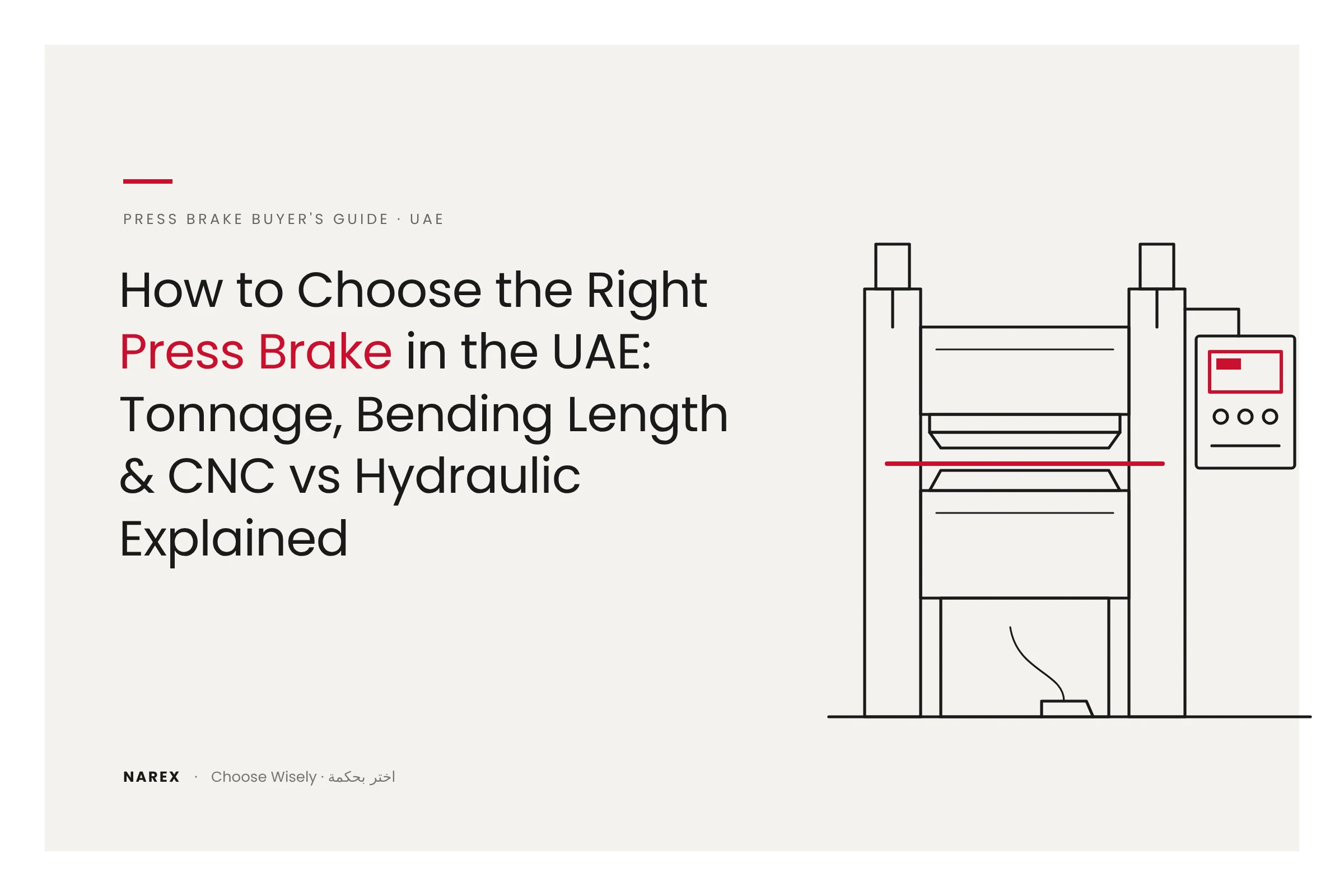
A press brake is a sheet metal bending machine that presses a punch into a V-die to fold flat sheet into an accurate angle. It is the standard machine for bending mild steel, stainless steel, aluminium and GI sheet in UAE fabrication workshops.
The upper beam, called the ram, carries the punch. The lower bed holds the V-die. When the ram moves down, the sheet is forced into the die opening and bends along a straight line.
In a modern hydraulic press brake, two cylinders drive the ram. Each side is controlled as a separate axis, known as Y1 and Y2. The machine keeps both sides level either mechanically, through a torsion bar, or electronically, in a synchronized hydraulic system.
A back gauge behind the tooling positions the sheet before each bend. This sets the flange length, so it decides how consistent your parts will be from the first piece to the last.
CNC vs hydraulic (NC) press brake: which suits your workshop?
Choose a CNC press brake when you run repeat jobs, multi-bend parts or frequent changeovers. Choose a hydraulic NC press brake when your parts are simple, batches are steady and budget matters most. Both are hydraulic machines; the difference is how the ram and back gauge are controlled.
| Factor | CNC press brake | Hydraulic NC press brake |
|---|---|---|
| Control | CNC controller programs ram depth (Y1/Y2), back gauge and bend sequence | NC controller sets ram depth and back gauge position for each bend |
| Repeatability | High; angles stay consistent across long batches | Good for single bends; depends more on operator checks |
| Setup time | Short; stored programs recall a part in minutes | Longer; each job is set and test-bent manually |
| Operator skill | Programming training needed; less hand adjustment once set | Experienced operator needed for angle correction |
| Cost | Higher purchase cost | Lower purchase cost |
| Suited to | Enclosures, cabinets, elevator panels, steel furniture, mixed jobs | Ducting, brackets, simple profiles, construction steel |
Many workshops searching for a CNC press brake in Dubai or Sharjah are moving from NC to CNC because of setup time. If your operators re-set the machine several times a day, the time saved often matters more than the price gap.
Choosing bending length for UAE sheet sizes
Match bending length to the longest sheet edge you fold. In the UAE, most mild steel, stainless and GI sheet is stocked as 1250 x 2500 mm or 1500 x 3000 mm, so 2,500 mm and 3,200 mm press brakes cover most workshops.
| Bending length | Fits sheet edge | Typical use |
|---|---|---|
| 1,600 mm | Cut blanks up to 1,500 mm | Small brackets, boxes, short panels |
| 2,500 mm | 1250 x 2500 sheet, long edge | Ducting, cabinets, general fabrication |
| 3,200 mm | 1500 x 3000 sheet, long edge | Elevator panels, cladding, long profiles, enclosures |
Two points to keep in mind. First, tonnage is rated over the full length; short bends need less force, but load them near the centre to protect the beam. Second, a longer machine takes more floor space and tooling, so do not over-size if your parts never exceed 2 m.
Narex press brake range in the UAE
Narex UAE supplies six press brake models from 40 to 250 tons, covering 1,600 mm to 3,200 mm bending lengths, under the Omega and Vox brands. All are listed on the press brake category page.
| Model | Brand | Tonnage | Length | Indicative mild steel at full length* | Suited to |
|---|---|---|---|---|---|
| PB1332 CNC | Omega | 130 t | 3,200 mm | up to ~4.5 mm | Repeat multi-bend parts, enclosures, elevator panels |
| VPB 250/3200 | Vox | 250 t | 3,200 mm | up to ~8.5 mm | Heavy plate, structural and construction steel |
| VPB 160/3200 | Vox | 160 t | 3,200 mm | up to ~5.5 mm | Medium plate, trailer and tank parts, heavier brackets |
| MPB 125/3200 | Omega | 125 t | 3,200 mm | up to ~4.3 mm | General fabrication, long panels, cladding |
| MPB 63/2500 | Omega | 63 t | 2,500 mm | up to ~2.8 mm | HVAC ducting, cabinets, light sheet work |
| MPB 40/1600 | Omega | 40 t | 1,600 mm | up to ~2.7 mm | Small parts, signage, brackets, start-up workshops |
*Calculated with the formula above, 8x V-die and about 10% headroom. Stainless capacity is roughly two-thirds of these values. Shorter bends allow thicker sheet. [CONFIRM: rated thickness per model from manufacturer data sheets]
Who each model is for
- Omega CNC Press Brake PB1332, 130 Ton x 3200 mm: workshops that need repeatable angles across batches and fast changeovers.
- Vox Hydraulic Press Brake VPB, 250 Ton x 3200 mm: steel structure and heavy fabrication shops bending thick plate.
- Vox Hydraulic Press Brake VPB, 160 Ton x 3200 mm: fabricators moving into 5 mm plate without the footprint of a heavy machine.
- Omega Hydraulic Press Brake MPB, 125 Ton x 3200 mm: general job shops bending full 1500 x 3000 sheets in mild steel, stainless and GI.
- Omega Hydraulic Press Brake MPB, 63 Ton x 2500 mm: HVAC/ducting and cabinet makers working mainly with 1250 x 2500 sheet.
- Omega Hydraulic Press Brake MPB, 40 Ton x 1600 mm: small workshops, signage makers and training centres bending short, thin parts.
Controller, stroke, daylight, motor power and back gauge travel for the hydraulic models.
Press brake applications by industry in the UAE and GCC
Most UAE buyers fall into one of six sectors, and each points to a different tonnage and control level.
| Industry | Typical material | Typical machine |
|---|---|---|
| HVAC and ducting | 0.5–1.5 mm GI sheet | 40–63 t hydraulic, 2,500 mm |
| Steel furniture and shelving | 0.8–2 mm mild steel | 63–125 t; CNC for repeat runs |
| Cabinets and electrical enclosures | 1.5–2 mm mild or stainless steel | 125–130 t CNC, 3,200 mm |
| Elevator and cladding panels | 1–2 mm stainless, aluminium | 130 t CNC, 3,200 mm |
| Signage and shopfitting | Aluminium, thin stainless | 40–63 t hydraulic |
| Construction and structural steel | 4–10 mm mild steel plate | 160–250 t hydraulic |
Shops in Sharjah, Dubai, Abu Dhabi and across KSA often serve several of these at once. In that case, size for the thickest regular job and use CNC if part variety is high.
A press brake rarely works alone. Most workshops pair it with a fiber laser cutting machine or a shearing machine to produce the flat blanks it bends.
Tooling, back gauge and crowning: what to check before buying
Before you sign, check four things: the tooling system, back gauge axes, crowning method and ram synchronization. These decide part consistency more than tonnage does.
- Tooling (punch and V-die): confirm the clamping standard and which punches and dies are included. A multi-V die covers several thicknesses; add a gooseneck punch if you bend deep boxes or return flanges.
- Back gauge: count the axes. A basic X-axis back gauge sets flange length; R (height) and Z (finger position) axes help with complex parts. Check travel and repeatability figures on the data sheet.
- Crowning: the ram and bed deflect slightly under load, so the centre of a long bend can open up. Crowning, manual wedges or CNC-controlled, compensates for this and keeps the angle consistent along 3,200 mm.
- Ram synchronization: torsion bar machines keep Y1 and Y2 level mechanically and suit standard work. Electro-hydraulic synchronized machines control each side separately and handle off-centre loads better.
- Safety: ask about light guards or front protection, rear guarding and foot-pedal emergency stops.
Ask to bend your own sample part during a demo. It is the fastest way to check all of the above. For guarding practice, the OSHA machine guarding guidance is a useful reference alongside local UAE safety rules.
Total cost of ownership: more than the machine price
The press brake machine price in the UAE is only part of the cost. Budget for five more items before comparing quotes in AED:
- Installation: foundation or floor preparation, power supply, hydraulic oil fill and levelling.
- Training: time for operators to learn the controller and safe bending practice.
- Tooling: extra punches and dies for new thicknesses or profiles, often added after year one.
- Maintenance: hydraulic oil and filter changes, seal checks and back gauge calibration.
- Spare parts and service: how fast a technician and parts reach your site when the machine stops.
Downtime is the hidden cost. A low-priced machine with spares shipped from overseas can lose more production days than it saves. Ask every supplier where their engineers and parts stock are based.
Why buy from Narex UAE, a press brake supplier in Sharjah
Narex UAE has supplied sheet metal and fabrication machinery from Sharjah since 1994, with local engineers, spare parts and service under one roof.
- Experience: part of Narex Group, established 1994, with more than 10,000 machines installed across the UAE, KSA, GCC and Africa.
- In-house engineers: a team of 35+ engineers handles installation, commissioning and service.
- Showroom in Sharjah: see machines at our showroom in Sharjah Industrial Area 2 before you buy.
- Operator training: one day of operator training after installation.
- Support: 24-hour support, with spare parts and service requests through service.narexuae.com.
- Regional reach: sister company Narex KSA serves buyers in Saudi Arabia.
Frequently asked questions
What is the price of a press brake machine in the UAE?
Press brake prices in the UAE depend on tonnage, bending length, CNC or NC control, tooling and back gauge axes. A 40 ton NC machine and a 130 ton CNC machine sit in very different price bands. Share your thickness, material and length with Narex UAE for an AED quotation.
What tonnage do I need to bend 3 mm mild steel?
About 75 tons for a 3 m bend using a 24 mm V-die, or about 90 tons with 20% headroom. A 125 or 130 ton, 3,200 mm press brake covers this comfortably.
Should I buy a CNC or hydraulic NC press brake?
Buy CNC if you run repeat jobs, multi-bend parts or several changeovers a day. Buy hydraulic NC if your parts are simple and your budget is tighter.
How often does a hydraulic press brake need maintenance?
Daily checks of oil level and guards, plus scheduled hydraulic oil and filter changes and back gauge calibration. Follow the manufacturer’s service intervals. [CONFIRM: recommended service intervals]
How long does press brake delivery take in the UAE?
Models in stock in Sharjah can be delivered and installed faster than machines ordered from the factory. [CONFIRM: typical delivery lead time for stock and ordered models]
Does Narex provide operator training?
Yes. Narex UAE provides one day of operator training after installation, covering controller use, setup and safe operation.